
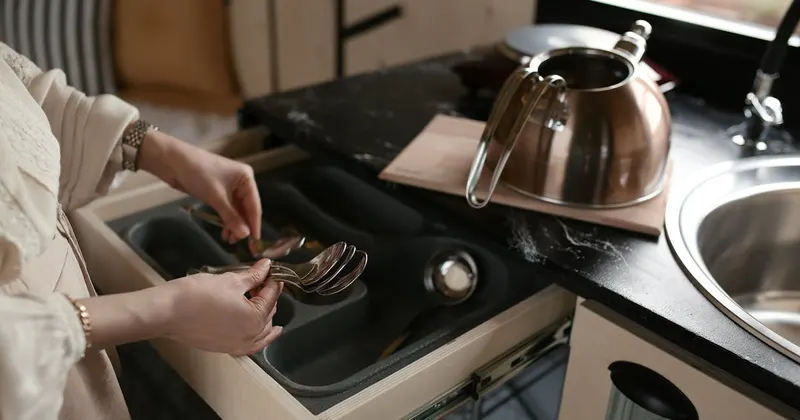
Professional chefs organize their kitchens around one principle: everything you need is within arm's reach of where you use it. Home kitchens rarely follow this logic ��� the mixing bowls live across the room from the measuring cups, the pots are stacked five deep, and the spices hide behind the canned goods. This guide applies restaurant kitchen organization principles to your home kitchen, creating a layout that saves time on every meal. North Houston home cooks who adopt these strategies report cutting meal prep time by 20-30 percent.
The Zone Principle: How Pros Think About Kitchen Layout
Professional kitchens are organized into stations — prep station, cooking station, plating station, cleaning station. Each station has every tool and ingredient needed for its function within arm's reach. You never see a chef walk across the kitchen for a spatula.
Apply the same principle to your home kitchen by creating zones around the three main work areas: the sink, the stove, and the refrigerator. These three points form the "kitchen triangle" that determines the most efficient cabinet assignments.
Zone 1: The Cooking Zone (Around the Stove)
Cabinets and drawers near the stove should contain everything related to cooking:
- Pots and pans — in the cabinet directly below or beside the stove. Use a pan organizer rack to stand them vertically rather than stacking
- Cooking utensils — in the drawer closest to the stove. Spatulas, wooden spoons, tongs, ladles
- Oils and vinegars — in the cabinet immediately adjacent to the stove for easy reach while cooking
- Spices — within arm's reach of the stove but not directly above it (heat degrades spices)
- Baking sheets and cutting boards — stored vertically with dividers in a nearby cabinet
Zone 2: The Prep Zone (Counter Space and Refrigerator)
The area between your refrigerator and your main counter workspace is the prep zone. Cabinets here should contain:
- Mixing bowls and measuring cups — together, because they are always used together
- Knives and cutting boards — in a drawer or block near the primary cutting area
- Food storage containers — near the counter where you pack leftovers
- Small appliances you use daily — toaster, blender, food processor in lower cabinets for quick retrieval
Move any appliance you use less than weekly to a higher cabinet or pantry shelf. Counter space is the most valuable real estate in your kitchen — do not waste it on the bread maker you use twice a year.
Zone 3: The Cleaning Zone (Around the Sink)
Cabinets near the sink handle cleaning, dishwashing, and trash management:
- Dish soap, sponges, and scrub brushes — in a caddy on the counter or in the cabinet directly under the sink
- Trash bags — under the sink or in the nearest cabinet
- Cleaning supplies — organized in a caddy under the sink
- Dish towels — in the drawer closest to the sink
Upper vs Lower Cabinet Strategy
The rule professional organizers follow: heavy items go in lower cabinets, lightweight and frequently used items go in upper cabinets at eye level. Items you rarely use go on the highest shelves.
- Eye level (upper cabinets) — everyday dishes, glasses, mugs, spices
- Waist level (lower cabinets) — pots, pans, appliances, mixing bowls
- Above eye level — serving platters, seasonal items, rarely used bakeware
- Below waist — heavy items like cast iron, large stockpots, bulk goods
Cabinet Organizers That Chefs Actually Use
- Shelf risers — double the usable space in any cabinet by creating a second level
- Turntables (lazy Susans) — essential for deep corner cabinets where items disappear in the back
- Pull-out drawers — retrofit inside lower cabinets so you can see and reach everything without kneeling and digging
- Lid organizers — store pot and pan lids vertically so they stop falling every time you open the cabinet
Maintaining the System
The zone system maintains itself because it is logical. When you finish using a pot, it goes back by the stove. When you wash a bowl, it goes back by the prep area. Items naturally return to where they are used.
Once a quarter, spend 15 minutes checking that nothing has migrated. Move stray items back to their zones, discard anything chipped or broken, and adjust shelf heights if needed. A well-organized kitchen combined with regular professional cleaning makes cooking more enjoyable and the entire kitchen more inviting.
Related Services
SparkTex Cleaners
Professional cleaning team serving North Houston. 64+ satisfied clients across 13 cities. Insured, background-checked teams with a 100% satisfaction guarantee.